
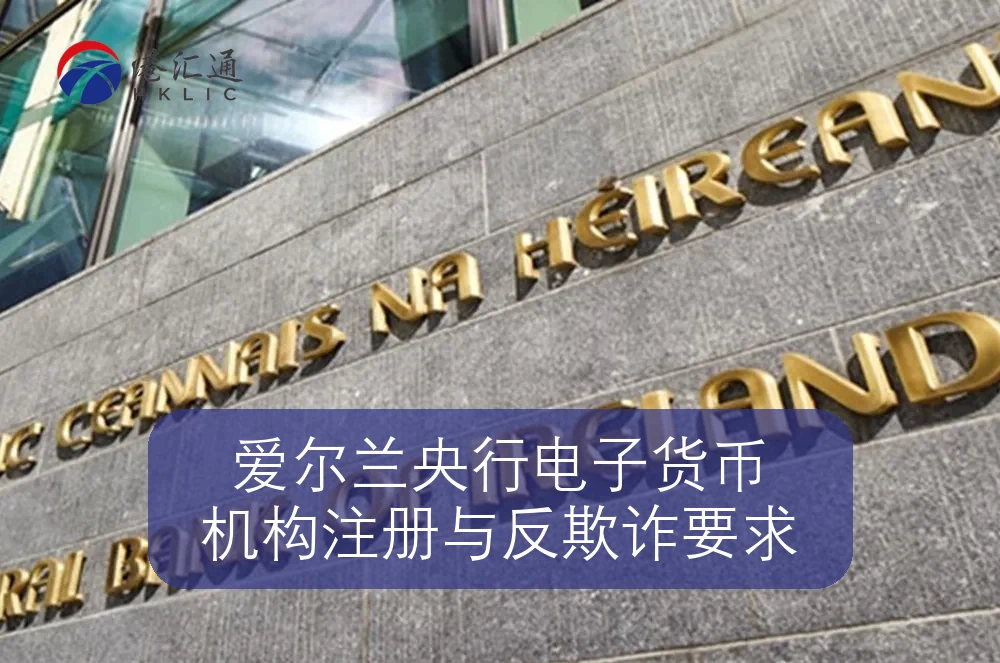
Irish Electronic Money Agency: CBI authorization, Capital and anti-fraud requirements

The Electronic Money Institution of Ireland (EMI) is authorized and supervised by the Central Bank of Ireland (CBI), Can issue electronic currency and provide related payment services within the permitted scope. Whether to choose Ireland should be based on business, Management, local substance, capital, Customer fund protection, system, Bank and target market judgment; CBI authorization does not constitute brand endorsement, Nor is it an unconditional "pass" to enter the entire EEA.. Cross-border notices can be found inEU EMI Passport Instructions.
如需比较其他地区的业务范围, Available支付与银行牌照服务目录; 爱尔兰的授权与持续要求仍须按CBI及当地法律单独核对.
Applicants must establish governance commensurate with the business, Customer fund protection, AML/CFT, Anti-fraud, ICT, Outsourcing and operational resilience arrangements. The authorization result is determined by CBI based on statutory standards and case materials..
one, Core regulatory framework for Irish EMI registration
Irish EMI is primarily regulated by the European Communities (Electronic Money) Regulations 2011; When providing payment services, you must also check the EU (Payment Services) Regulation 2018 and subsequent amendments. Applicants must prove business to CBI, governance, personnel, capital, Customer fund protection, AML/CFT, ICT and exit arrangements comply with current requirements.
During the application process, Regulators focus on the following areas::
- Governance and internal controls: Enterprises must have a clear organizational structure, Ensure that the board of directors and senior management can effectively supervise business operations.
- capital requirements: EMI initial capital must not be less than 350,000 euros, and must continue to meet at least no less than the initial capital and applicable self-funding requirements based on average outstanding electronic money and incidental payment services.
- Customer fund protection: Relevant client funds must be safeguarded in accordance with applicable rules, Isolation or qualifying insurance/guarantee available; Account, assets, Reconciliation and return arrangements must be consistent with actual business.
Governance arrangements should make it clear that the board of directors, Management and risks, Compliance, AML/CFT, Internal Audit and ICT Function Responsibilities, independence, Resources and Substitutes. External consultants cannot ensure architecture is CBI accredited.
two, Anti-Fraud and AML Compliance: The Bank of Ireland’s regulatory red lines
In the current regulatory environment, Anti-Money Laundering (AML) and Anti-Fraud(Fraud Prevention) is no longer a simple background job, It is the core competitiveness of EMI institutions.. The Central Bank of Ireland clearly requires institutions to establish a risk-based approach (Risk-based Approach) prevention system.
1. Customer Due Diligence (CDD) and KYC Practice
Institutions are required to identify and verify customers and beneficial owners in accordance with Irish AML/CFT laws, and take enhanced due diligence in high-risk situations. FATF beneficial ownership materials provide international context, but does not replace Irish law, CBI requirements and specific risk assessment.
2. Real-time transaction monitoring and abnormal behavior analysis
Transaction monitoring and anti-fraud controls are subject to product, client, channel, Geographical and transaction risk commensurate, and tested, Threshold adjustment, Alarm investigation and governance supervision. CBI does not require that all EMI must adopt specific technologies with "self-learning" capabilities.
3. Reporting mechanism and law enforcement cooperation
Once suspicious transactions are discovered, Institutions must comply with the provisions of the Criminal Justice (Money Laundering and Terrorist Financing) Act 2010, Prompt submission of suspicious transaction reports (STR) to the Irish Financial Intelligence Unit (FIU).
three, Application preparation and boundaries of responsibility
Applications usually involve business plans, financial forecast, governance and people, Customer fund protection, AML/CFT, Anti-fraud, ICT, outsourcing, Business continuity and exit arrangements. CBI may request supplementary documents or management explanations, However, the number of inquiries and total cycle time depends on the individual case, Cannot preset "multiple rounds" or guarantee avoidance of rejection.
Professional support provided by Hong Kong Huitong:
- Pre-Application Assessment: Assess whether your company’s business model complies with the Bank of Ireland’s business scope definition for EMI licenses.
- Policy document support: Assist in preparing AML/CFT based on actual business, Compliance, Anti-fraud, ICT and data protection documents, and reviewed by the applicant’s management, Approval and responsible for execution.
- Manager preparation: Assist in sorting out responsibilities, Experience and fit and proper materials; Irish EMI should not use the "RO" title in general, Personnel qualifications and inputs are reviewed by CBI on a case-by-case basis.
- Management presentation preparation: Can assist managers in understanding their responsibilities and checking material consistency, But do not pretend to be a CBI process, There is no guarantee that inquiries, Interview or authorization results.
Application and Compliance Points: Central Bank of Ireland Electronic Money Institution Registration and Anti-Fraud Requirements
Irish EMI mandate should be issued from Electronic Money, payment account, Domestic or cross-border transfers, Merchant Acquirer, Payment initiation and account information services are judged item by item. Digital token services are not automatically approved for obtaining EMI; It must also be evaluated according to MiCA and other applicable systems.
Things to prepare and keep checking
- When choosing an EU member state, In addition to minimum capital, It is also necessary to compare the expectations of the competent authorities, Local management and staff, Where core systems and accounting books are located, Bank resources and host country supervision after passport notification.
- Start by doing a regulated activity matrix, Differentiate payment accounts, transfer, Acquiring, Electronic currency issuance, Payment initiation, Account information and digital token services.
- Client fund protection should be clearly defined using segregated accounts or insurance/guarantee, When to start protection, How to reconcile daily, How to deal with the difference and how to return it when the institution goes bankrupt.
- The business plan should provide three-year transaction volume and revenue forecasts, Agency and Outsourcing, Banks and Card Organizations, IT architecture, Fraud and AML, Operational resilience and exit planning.
- EEA cross-border services rely on home country notification, Service model and applicable rules of the host country; The UK does not fall within the EEA passport scope, Entry into the UK or other markets outside the EEA requires separate confirmation of permission, registration or exemption.
Costs involved, capital, time limit, When personnel qualifications or cross-border business scope, Please refer to the legislation published by the competent authority at the time of submission, Forms and guidelines are subject to.
Four, Frequently Asked Questions (FAQ)
Q1: After obtaining Irish EMI license, Is it possible to do business in other EU countries?
Available through cross-border services when eligible, Agent or branch notification to enter other EEA countries, Subject to completion of applicable procedures and compliance with host country rules. CBI authorization itself does not mean that it can operate immediately and unconditionally throughout the EEA.
Q2: Does the Central Bank of Ireland have mandatory requirements for the technical selection of anti-fraud systems?
Although no specific software vendor was specified, But regulators require systems to be effective "commensurate with the scale of business risks". Organizations need to conduct regular system performance assessments, and provide supporting materials to the central bank.
Q3: How does Hong Kong Huitong help us deal with complex offshore structure issues?
Can assist in sorting out equity according to written range, Control and UBO information, However, the holding and tax structure must be determined by the applicant, Lawyers and tax consultants determine based on actual circumstances. There is no unified "most reasonable" architecture, There is no guarantee of passing CBI review.
Summarize
Is Ireland EMI suitable for the project?, Should be based on business scope, capital, Management, local substance, Customer fund protection, Anti-fraud, System and target market judgment. External support is available on a written basis, Hong Kong Huitong staff resume, Project experience and confidentiality capabilities must be based on verifiable information and contracts..
References: central bank of ireland: Payment and Electronic Money Institution Authorization (English), Ireland European Communities (Electronic Money) Regulations 2011 (English), Ireland EU (Payment Services) Regulations 2018 (English), EBA: Payment Services and Electronic Money Information (English).
learn more: EU EMI License Passport Guide.